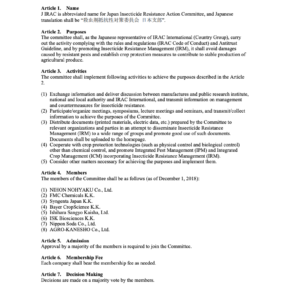
J IRAC is abbreviated name for Japan Insecticide Resistance Action Committee, and the Japanese translation is “殺虫剤抵抗性対策委員会 日本支部”.
The Japan IRAC Group evolved from the local Diamide/Lepidoptera Working Group but has now formed a full IRAC Country Group by broadening their remit to include other pest species and chemistries as well as inviting membership from other companies.
The first meeting of J IRAC in the Japan Crop Protection Association, a CropLife member in Japan, was held on the 23rd October 2019. A new J IRAC Code and the working group organization will be finalized in the next meeting in December.
The members of the Committee are as follows:
NIHON NOHYAKU CO.,LTD
HOKKO CHEMICAL INDUSTRY CO., LTD.
Kyoyu Agri Co., Ltd.
FMC CHEMICALS K.K.
Syngenta Japan K.K.
Nissan Chemical Corporation
SUMITOMO CHEMICAL COMPANY, LIMITED
Corteva Japan Ltd.
KUMIAI CHEMICAL INDUSTRY CO.,LTD.
Bayer CropScience K.K.
ISHIHARA SANGYO KAISHA, LTD.
SDS Biotech K.K.
BASF Japan Ltd.
MITSUI CHEMICALS CROP & LIFE SOLUTIONS, INC.
NIPPON SODA CO., LTD.
AGRO-KANESHO CO., LTD.
MARUWA BIOCHEMICAL CO.,LTD.
ZEN-NOH, National Federation of Agricultural Cooperative Associations (Observer)
The activities of IRAC Japanwill include :
Exchange of information between manufacture, public research institute, national and local authority and IRAC International on the management and counter-measures for insecticide resistance.
Organising and participating in meetings, symposiums, lectures and seminars
Distribution of documents (printed and electronic materials etc.) prepared by the Committee to relevant organizations and parties to disseminate and promote Insecticide Resistance Management (IRM). Documents will also be made available on the IRAC website.
Promotion of Integrated Pest Management (IPM) and Integrated Crop Management (ICM) incorporating IRM through the use of crop protection technologies such as physical and biological control) as well as chemical control.
REPORT IN BRIEF FROM 2021/22:
Research activity is particularly focused on Thrips tabaci and Spodoptera exigua but there is limited data access and non-uniform methodology of the resistance monitoring by public institutes.
Spodoptera frugiperda is not an important resistance research target as there is no hibernation in Japan and host plants are limited to corn and sugarcane.
Introduction of a “Resistance Risk Matrix” into the local spray calendar with a decision in progress by the Agricultural and Forest Insect Pest Management Society of Japan.
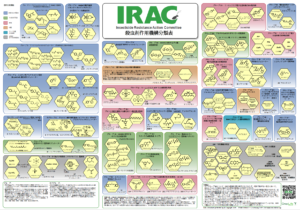
J IRAC gave a presentation the annual meeting of JSAEZ, regarding the update of the MoA classification and IRAC’s “windows rotation” strategy During the annual meeting a seminar about the spray calendar focusing on Thrips tabaci was organized (in conjunction with the “Agricultural and Forest Insect Pest Management & the Japanese Society of Applied Entomology and Zoology JSAEZ)
The first report of the Tuta absoluta in the field in southern Japan (Kyushu island) was confirmed last year. Prior to this only quarantine incidents had been reported.