Melon & Cotton Aphid
Aphis gossypii
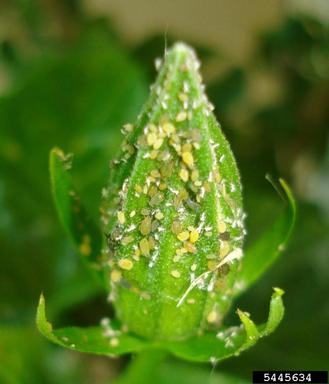
Aphis gossypii Glover (Hemiptera: Aphididae) is a destructive pest of numerous crops worldwide. This sap-sucking insect affects plants via direct feeding and indirectly via plant viral disease transmission (more than 50 plant pathogenic viruses known). It has…
Collapse pest biology
Aphis gossypii Glover (Hemiptera: Aphididae) is a destructive pest of numerous crops worldwide. This sap-sucking insect affects plants via direct feeding and indirectly via plant viral disease transmission (more than 50 plant pathogenic viruses known). It has a very wide host range with at least 700 host plants being known world-wide. It can seriously affect most cucurbit and solanaceous vegetable crops as well as leafy vegetables, legumes, potato, ornamentals, stone fruits, oil seed rape, citrus, cotton or many other important crops.
It has a short generation time and high fecundity that result in an enormous reproductive potential. The adults and nymphs of A. gossypii feed on the underside of leaves or on the growing tips of shoots, sucking juices from the plant. The foliage may become chlorotic and die prematurely. There is often a great deal of leaf curling and distortion which hinders efficient photosynthesis. Honeydew is excreted by the aphids and this allows sooty moulds to grow, resulting in a decrease in the quantity and quality of the produce. The aphids are difficult to control because of the high propagation rate and its ability to evolve resistance to many insecticide classes.
Other common names
Melon Aphid, Cotton aphid

Resistance status
| Insecticide group | Region | Suspected mechanism |
|---|---|---|
| CarbamatesMoA 1AAphis gossypii | Worldwide | Metabolic-Elevated level of Carboxylesterase |
| OrganophosphatesMoA 1BAphis gossypii | Worldwide | Metabolic-Elevated level of Carboxylesterase |
| Pyrethroids-PyrethrinsMoA 3AAphis gossypii | Worldwide | Metabolic-Elevated level of Carboxylesterase |
| CarbamatesMoA 1AAphis gossypii | Worldwide | Metabolic- Elevated level of Monoxigenase P450 |
| OrganophosphatesMoA 1BAphis gossypii | Worldwide | Metabolic- Elevated level of Monoxigenase P450 |
| Cyclodiene organochlorinesMoA 2AAphis gossypii | Worldwide | Metabolic- Elevated level of Monoxigenase P450 |
| Phenylpyrazoles (Fiproles)MoA 2BAphis gossypii | Worldwide | Metabolic- Elevated level of Monoxigenase P450 |
| Pyrethroids-PyrethrinsMoA 3AAphis gossypii | Worldwide | Metabolic- Elevated level of Monoxigenase P450 |
| NeonicotinoidsMoA 4AAphis gossypii | Worldwide | Metabolic- Elevated level of Monoxigenase P450 |
| CarbamatesMoA 1AAphis gossypii | Non specified | Target site – S431F, A302S |
| OrganophosphatesMoA 1BAphis gossypii | Non specified | Target site – F139L, A302S |
| Pyrethroids-PyrethrinsMoA 3AAphis gossypii | Non specified | Target site- L1014F, M918L |
| NeonicotinoidsMoA 4AAphis gossypii | South-East Asia | Target site – R81T |
| SulfoximinesMoA 4CAphis gossypii | South-East Asia | Target site – R81T |
| FlonicamidMoA 29Aphis gossypii | South-Korea, USA | Non specified |
The control of cotton aphids typically rely on chemical insecticides for a long time. Consequently, cotton aphids have evolved resistance to a wide range of insecticides, including organochlorines, organophosphates, carbamates, pyrethroids, and neonicotinoids. Both metabolic and target…
Collapse resistance summary
The control of cotton aphids typically rely on chemical insecticides for a long time. Consequently, cotton aphids have evolved resistance to a wide range of insecticides, including organochlorines, organophosphates, carbamates, pyrethroids, and neonicotinoids. Both metabolic and target site mutations can occur in some populations resulting resistance to multiple insecticide classes. Below table shows the major resistance mechanisms and the impacted chemical classes.