
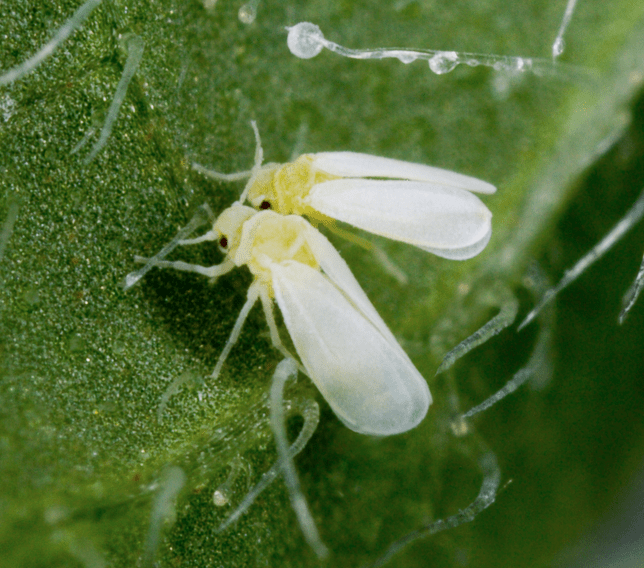
Tobacco Whitefly
Bemisia tabaci
Bemisia tabaci Gennadius (Hemiptera: Aleyrodidae) is one of the world’s top 100 invasive organisms found on over 900 host plants all around the world. It is currently recognized as a complex of cryptic species with world wide distribution.…
Collapse pest biology
Bemisia tabaci Gennadius (Hemiptera: Aleyrodidae) is one of the world’s top 100 invasive organisms found on over 900 host plants all around the world. It is currently recognized as a complex of cryptic species with world wide distribution. The two most important phylogenetic groups of B. tabaci from an agricultural perspective are MEAM1 (Middle East-Asia Minor 1; also commonly known as biotype B) and MED (Mediterranean; including the commonly known biotype Q among others). It reportedly transmits over a hundred virus species some of which are of high economic importance. The whitefly thrives in tropical, subtropical, and less predominately in temperate habitats. It is also a major pest of glasshouses.
Infestation is easily recognized by examining the undersides of leaves, where all stages of the insect can usually be found. The infested leaves will start to show a yellow mosaic, with the green areas becoming ever smaller. Twisting of stems and curling of leaves may occur, and the plants may become stunted. Heavily-infested leaves often wilt and fall off. In addition to direct feeding, all stages damage the plants through abundant production of honeydew, which encourages the growth of sooty molds, and, most importantly, by the transmission of viruses.
Other common names
Sweet Potato Whitefly

Resistance status
| Insecticide group | Region | Suspected mechanism |
|---|---|---|
| CarbamatesMoA 1A | Worldwide | Metabolic-Elevated level of Carboxylesterases |
| OrganophosphatesMoA 1B | Worldwide | Metabolic-Elevated level of Carboxylesterases |
| Pyrethroids-PyrethrinsMoA 3A | Worldwide | Metabolic-Elevated level of Carboxylesterases |
| NeonicotinoidsMoA 4A | Worldwide | Metabolic-Elevated level of Monoxigenase P450 |
| PymetrozineMoA 9B | Worldwide | Metabolic-Elevated level of Monoxigenase P450 |
| PyriproxyfenMoA 7C | Worldwide | Metabolic- Elevated level of Monoxigenase P450 |
| CarbamatesMoA 1A | Worldwide | Target site – MACE (Acetilcolinesterase modification) |
| Pyrethroids-PyrethrinsMoA 3A | Worldwide | Target site- L925I, M918V, T929V |
| Cyclodiene organochlorinesMoA 2A | Non specified | Target site – A302S/N |
| Phenylpyrazoles (Fiproles)MoA 2B | Non specified | Target site – A302S/N |
B. tabaci has tremendous potential to develop resistance to insecticides. The two most damaging biotypes of B. tabaci are the MEAM1 and MED biotypes. The MEAM1 -type has a worldwide distribution. The MED-type was largely restricted…
Collapse resistance summary
B. tabaci has tremendous potential to develop resistance to insecticides. The two most damaging biotypes of B. tabaci are the MEAM1 and MED biotypes. The MEAM1 -type has a worldwide distribution. The MED-type was largely restricted to the Mediterranean area but has recently moved to the U.S.A and China. To date, B. tabaci has shown resistance to more than 50 active ingredients of insecticides and several multi-resistant B. tabaci populations, particularly of the MED biotype, have also evolved in the field. The table below shows the major resistance mechanisms and the impacted chemical classes.
Resistance management recommendations
Integrated Pest Management (IPM)
- Monitoring and economic thresholds
Pest populations should be monitored and insecticides only applied, if economic threshold are exceeded. - Sanitation, removal of volunteer- or alternative host plants
Elimination of volunteer plants before sowing or transplant reduces the risk of pests and diseases surviving between crops. - Crop rotation
Rotation between host and non-host crops. - Application of physical barriers
Several physical control measures are available for B. tabaci, including the use of interception (netting), color (netting or foils), and vibration.
Suffocation of insects, using fatty acids - Biological control, mainly used in greenhouses
The introduction of natural enemies such as parasitic wasps or predators is a common IPM strategy used under glass or in specialty crops
Microbial control products based on entomopathogenic fungi can be applied using standard spray equipment - Host plant resistance
For certain crops, varieties are available that are either tolerant or fully resistant toward plant diseased transmitted by whiteflies.
Key resources
Key references
| Reference | Year | Authors | Publisher |
|---|---|---|---|
| Identification and functional characterization of a novel acetyl-CoA carboxylase mutation associated with ketoenol resistance in Bemisia tabaciVol. 166, 104583 | 2020 | Lueke B, Douris V, Hopkinson JE, Maiwald F, Hertlein G, Papapostolou KM, Bielza P, Tsagkarakou A, Van Leeuwen T, Bass C, Vontas J, Nauen R | Pesticide Biochemistry and Physiology |
| Insecticide resistance and control failure likelihood of the whitefly Bemisia tabaci (MEAM1; B biotype): a Neotropical scenarioVol. 172 (1), pp. 88-99, DOI: 10.1111/aab.12404 | 2018 | Dângelo RAC, Michereff-Filho M, Campos MR, da Silva PS, Guedes RNC | Annals of Applied Biology |
| The global status of insect resistance to neonicotinoid insecticidesVol. 121, pp. 78-87. DOI: 10.1016/j.pestbp.2015.04.004 | 2015 | Bass C, Denholm I, Williamson MS, Nauen R | Pesticide Biochemistry and Physiology |