
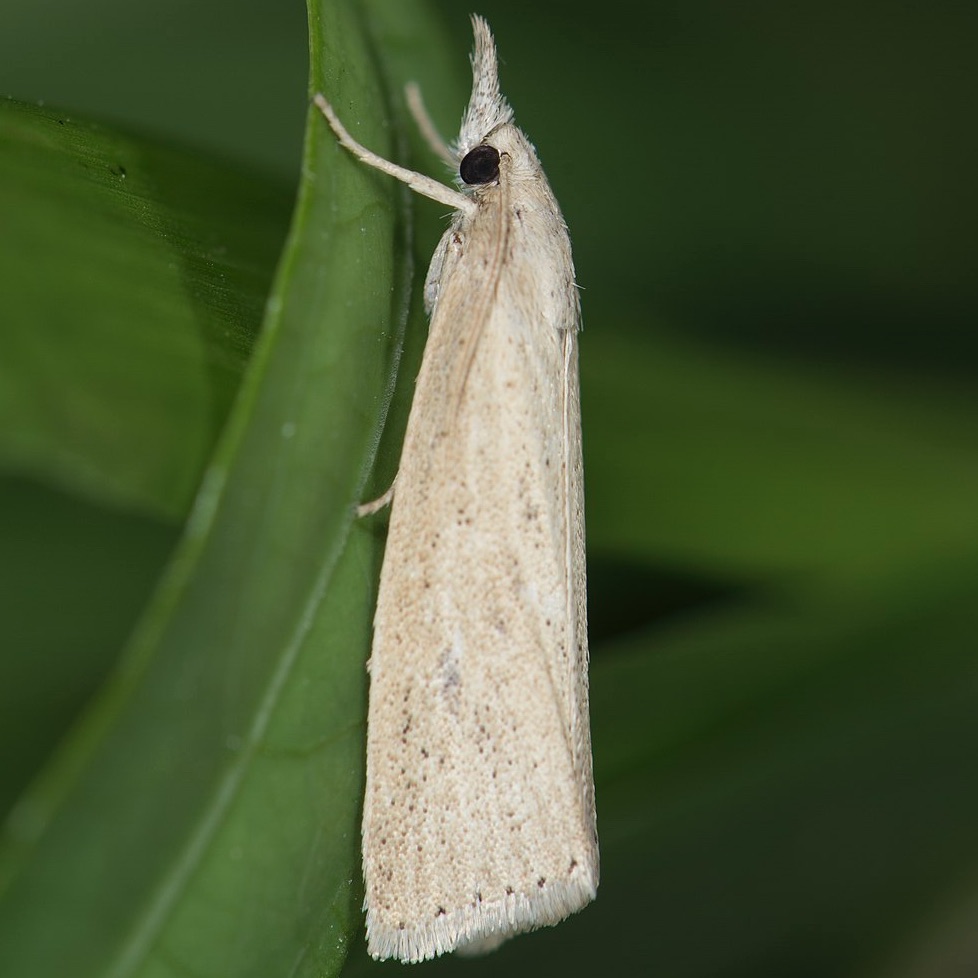
Chilo suppressalis
Chilo suppressalis
Symptoms vary, depending on the age of the plants. When young plants are attacked (which often happens while they are still in the seed bed), the first symptoms are the dying-off of growing points and the…
Collapse pest biology
Symptoms vary, depending on the age of the plants. When young plants are attacked (which often happens while they are still in the seed bed), the first symptoms are the dying-off of growing points and the surrounding leaves (“dead heart“). In contrast, infested older plants first show yellow, dried out leaves. Their outer leaves curl, the leaf sheaths turn yellow, and finally, the leaves fall off. Heavy infestation can lead to stems being hollowed-out completely, and to the formation of empty panicles, a condition commonly called “white head”.
In most areas, C. suppressalis has two generations per year; in some northern parts of its distribution area (e.g. northern Japan), only one. However, under favorable conditions such as those in the tropics, up to six generations are possible.
The larvae overwinter in stubble and straw, and they are able to survive mild frost during their diapause. Egg deposition always occurs in the morning. The female lays its ca. 300 eggs in several batches on the undersides of leaves, usually along the main vein, and covers them with a brown secretion. After 6-10 days, the larvae hatch and start feeding on the leaf epidermis. Then they tunnel into the leaf sheaths, thus causing the leaves to yellow, and later, to die off. When the larvae reach the stem, they hollow it out one internode at a time, penetrating through successive nodes. One larva can destroy several plants.
The whole generation cycle lasts between 35 and 70 days, depending on climatic conditions.
(Bayer Crop Compendium)
Other common names
Rice stem borer, Rice striped stem borer

Resistance monitoring
Susceptibility test methods approved by IRAC.
- Test Method 034Larvae / Dip
Key references
| Reference | Year | Authors | Publisher |
|---|---|---|---|
| Changes in Insecticide Resistance of the Rice Striped Stem Borer (Lepidoptera: Crambidae)Vol. 107 (1), pp. 333-341. DOI: 10.1603/EC13285 | 2014 | Zhang JSZ, Wu M, Gao C | Journal of Economic Entomology |
| Comparison of dose responses and resistance ratios in four populations of the rice stem borer, Chilo suppressalis (Lepidoptera: Pyralidae), to 20 insecticidesVol. 64 (3), pp. 308-315. DOI: 10.1002/ps.1522 | 2008 | He Yp, Gao CF, Chen WM, Huang LQ, Zhou WJ, Liu XG, Shen JL, Zhu YC | Pest Management Science |
| Fipronil resistance mechanisms in the rice stem borer Chilo suppressalis WalkerVol. 89 (3), pp. 169-174. DOI: 10.1016/j.pestbp.2007.06.002 | 2007 | Li X, Huang Q, Yuan J, Tang Z | Pesticide Biochemistry and Physiology |