
Codling Moth
Cydia pomonella
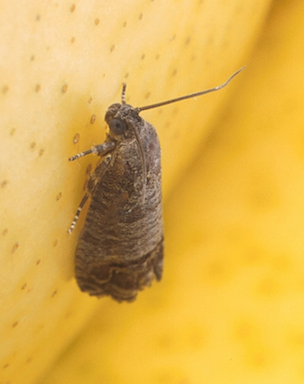
Cydia pomonella adults have a wingspan of about 15-22 mm. Their forewings are gray to dark brown and bear a copper-colored circular marking near the tip of the forewing; the hindwings are brown. The larvae are…
Collapse pest biology
Cydia pomonella adults have a wingspan of about 15-22 mm. Their forewings are gray to dark brown and bear a copper-colored circular marking near the tip of the forewing; the hindwings are brown. The larvae are white when newly hatched, but soon become pink and are up to 20 mm long. C. pomonella females lay 50-100 single eggs each, directly on the developing fruits or on adjacent leaves or shoots. The larvae hatch 5-18 days later and shortly after they penetrate the fruit where they pass through five stages during a period of 3-5 weeks, feeding on the immature seeds and the interior of the fruit.
The last instar before pupation will come out of the fruit again, and hide in a crack in the bark or a similar place to complete its development. C. pomonella can have 1-4 generations per year, depending on climate. Diapausing larvae are able to withstand rather low temperatures although severe frost will, kill many. In spring, when temperatures climb to above 10°C (50°F), they pupate inside the cocoon and 2-4 weeks later the adult moths emerge, at about the end of bloom.
The codling moth originated in Asia Minor but is nowadays spread all over the world, wherever apples are grown. Resistance to a specific insecticide can be due to different mechanisms, metabolic resistance (modified enzymatic activity: MFO, GST, EST), target-site resistance (KDR, MACE) and reduced penetration and behavioural changes. Metabolic resistance the most relevant for C. pomonella.

Resistance status
The codling moth originated in Asia Minor but is nowadays spread all over the world, wherever apples are grown. Resistance to a specific insecticide can be due to different mechanisms, metabolic resistance (modified enzymatic activity: MFO,…
Collapse resistance summary
The codling moth originated in Asia Minor but is nowadays spread all over the world, wherever apples are grown. Resistance to a specific insecticide can be due to different mechanisms, metabolic resistance (modified enzymatic activity: MFO, GST, EST), target-site resistance (KDR, MACE) and reduced penetration and behavioural changes. Metabolic resistance the most relevant for C. pomonella.
Key resources
Key references
| Reference | Year | Authors | Publisher |
|---|---|---|---|
| Determination of resistance and resistance mechanisms to thiacloprid in cydia pomonella L. (Lepidoptera: Tortricidae) populations collected from apple orchards in Isparta Province, TurkeyVol. 91, pp. 82-88. DOI: 10.1016/j.cropro.2016.09.015 | 2017 | İşci M, Ay R | Crop Protection |
| Resistance of Spanish codling moth (Cydia pomonella) populations to insecticides and activity of detoxifying enzymatic systemsDOI: 10.1111/j.1570-7458.2010.01088.x, Vol. 138 (3) pp. 184-192 | 2011 | Rodríguez MA, Bosch D, Avilla J | Entomologia Experimentalis et Applicata |
| Resistance of codling moth, Cydia pomonella (L.) (Lepidoptera: Tortricidae), larvae in Michigan to insecticides with different modes of action and the impact on field residual activityDOI: 10.1002/ps.1576Vol 64(9):881-90. | 2008 | Mota-Sanchez D, Wise JC, Poppen RV, Gut LJ, Hollingworth RM | Pest Management Science |
 UC Pest Management Guidelines – Cydia pomonella