
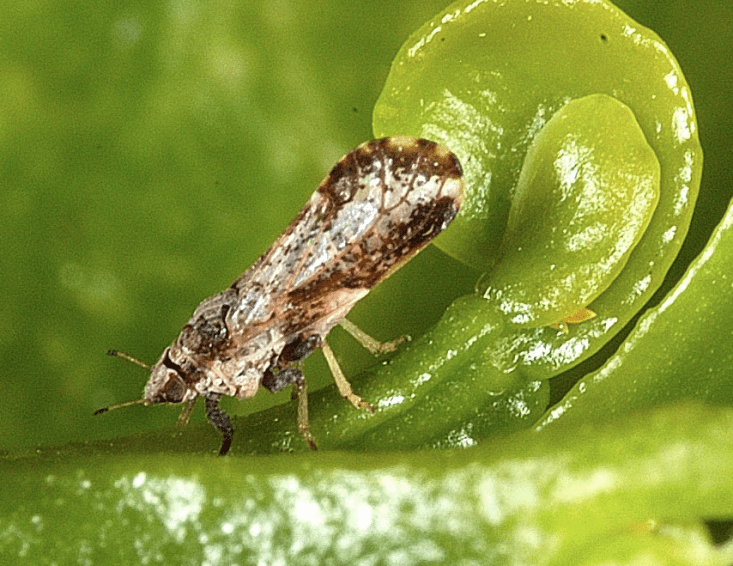
Asian Citrus Psyllid
Diaphorina citri
Diaphorina Citri is the insect vector associated with the transmission of the bacteria Candidatus Liberobacter asiaticus and Can. L. americanus. These bacteria are considered to be the causal agents of Huanglongbing (HLB) in Asia and Americas.…
Collapse pest biology
Diaphorina Citri is the insect vector associated with the transmission of the bacteria Candidatus Liberobacter asiaticus and Can. L. americanus. These bacteria are considered to be the causal agents of Huanglongbing (HLB) in Asia and Americas. Trees infected with the bacterial pathogen begin to show symptoms such as early fruit drop and mottled leaves anywhere from 5 months to 3 years after infection. Even during this asymptomatic period, plants can also be source of inoculum, hence the importance to manage the vector even if the trees are not showing symptoms. Once the trees are infected, if the vector and disease is not managed, the production rapidly declines rendering the infected trees unproductive in a few years.
Citrus psyllids lay their eggs on the inner-side of unfolding leaves which protect the eggs and early nymphs from adequate insecticide contact, rendering applications of non-systemic insecticides inefficient to manage nymphs. The psyllid nymphal stage has 5 instars taking between 15 and 47 days to become adults depending on environmental conditions. Nymphs acquire the bacteria and the adults vector the disease to uninfected plants and to plants that are already infected, increasing the bacterial titer in already diseased plants. Adults are considered to be the preferred target for foliar insecticide applications since they vector the bacteria. Systemic soil insecticide target nymphs and adults for the first 2 years after planting, after that period, threes are too big for the current chemistries to be effective.

Resistance status
| Insecticide group | Region | Suspected mechanism |
|---|---|---|
| OrganophosphatesMoA 1B | Pakistan, US | Unknown – From field tests |
| Pyrethroids-PyrethrinsMoA 3A | Pakistan, US | Unknown – From field tests. Metabolic resistance suspected |
| NeonicotinoidsMoA 4A | Pakistan, US | Unknown – From field tests |
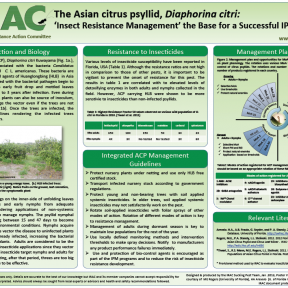
Various levels of insecticide susceptibility have been reported in Florida, USA. Although the resistance ratios are not high in comparison to some other pests, it is important to be vigilant to prevent the onset of resistance.…
Collapse resistance summary
Various levels of insecticide susceptibility have been reported in Florida, USA. Although the resistance ratios are not high in comparison to some other pests, it is important to be vigilant to prevent the onset of resistance. In this table only LC50 RR >10 have been included
Key resources
Key references
| Reference | Year | Authors | Publisher |
|---|---|---|---|
| Thirty-minute test to detect insecticide resistance under field conditions: the case of the Asian citrus psyllidVol 79, 9, Pg 3159-3166 | 2023 | Pardo-Melgarejo S, Rodríguez-Maciel JC, Pineda S, Lagunes-Tejeda A, Guzmán-Franco AW, Silva-Aguayo G, Ramírez-Sánchez AK | Pest Management Science |
| Monitoring of insecticide resistance in Diaphorina citri Kuwayama (Hemiptera: Psyllidae) from citrus groves of Punjab, PakistanVol. 86, pp. 62-68. DOI: 10.1016/j.cropro.2016.04.010 | 2016 | Naeem A, Freed S, Jin F, Akmal M, Mehmood M | Crop Protection |
| Insecticide resistance in field populations of Asian citrus psyllid in Florida1258-68. doi: 10.1002/ps.218 | 2011 | Tiwari S, Mann RS, Rogers ME, Stelinski LL | Pest Management Science |