
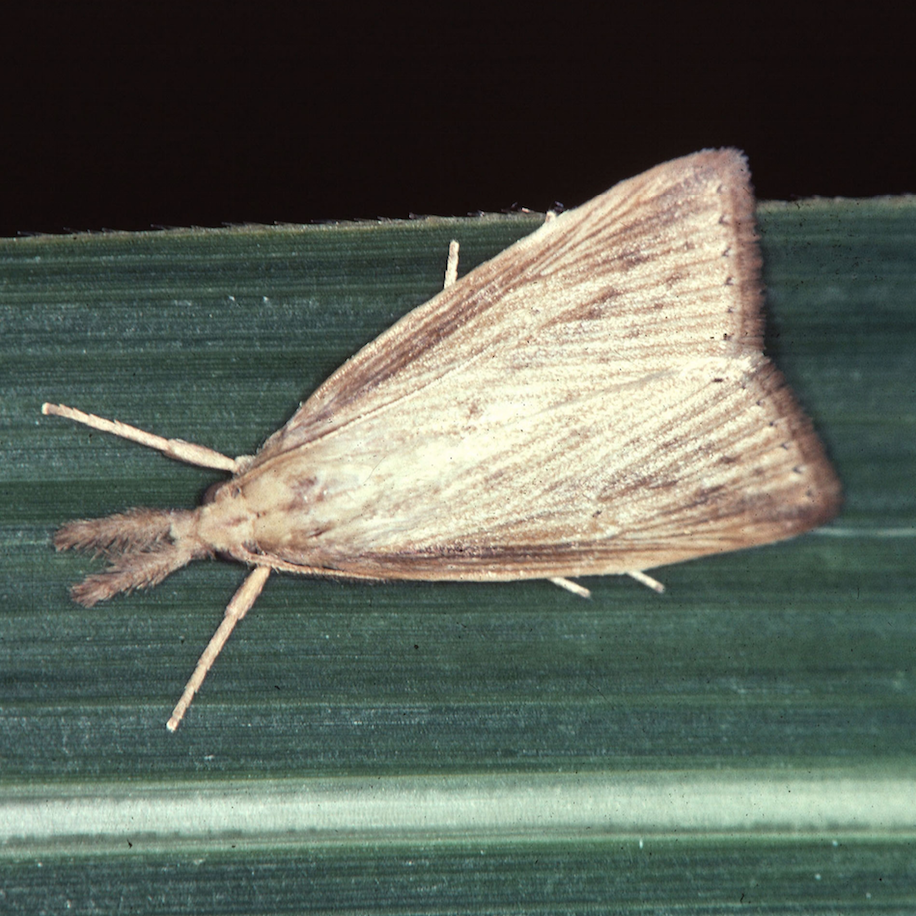
Sugarcane Borer
Diatraea saccharalis
Sugarcane borer attacks plants in the family Gramineae (grasses). Though principally a pest of sugarcane, this insect also will feed on other crops such as corn, rice, sorghum, and sudangrass. Many wild or weed grasses are…
Collapse pest biology
Sugarcane borer attacks plants in the family Gramineae (grasses). Though principally a pest of sugarcane, this insect also will feed on other crops such as corn, rice, sorghum, and sudangrass. Many wild or weed grasses are suitable hosts.
It is native to the Caribbean, Central America, and the warmer parts of South America south to northern Argentina.
Overwintering occurs in the larval stage, with pupation in the spring. Adults become active by April or May, and the borer population continues to cycle until autumn. Development time is highly variable, so the generations overlap considerably. There is potential for four to five generations to occur annually, but moths are abundant only in spring and autumn. During the summer a complete generation may require only 25 days.
Larvae bore into the sugarcane stalks. In mature plants the tops tend to weaken or die, sometimes breaking off. In young plants the inner whorl of leaves is killed, resulting in a condition known as “dead heart.”
Sugarcane borer could damage sweet corn in two ways. During early in the season, they may attack the whorl, feeding on the young developing tissue, resulting into a series of holes across the leaf blade. If such damage is extensive, the growing point of the plant may be killed and plant growth stunted. Later in the season the larvae descend to the stalk and burrow in. Large larvae tunnel through the stalk, causing the plant to be prone to breakage. On occasion, especially during the second generation, larvae may burrow into corn ears.

Resistance status
| Insecticide group | Region | Suspected mechanism |
|---|---|---|
| Bacillus thuringiensis and the insecticidal proteins they produceMoA 11A | US, Brazil | Reduced expression of aminopeptidases & cadherin (Yang 2011) |
Resistant cultivars of sugarcane display considerable resistance to sugarcane borer. Likewise, resistant transgenic corn varieties are currently being used to reduce the incidence of sugarcane borer in corn. In Arthropod Pesticide Resistance Database, there are papers…
Collapse resistance summary
Resistant cultivars of sugarcane display considerable resistance to sugarcane borer. Likewise, resistant transgenic corn varieties are currently being used to reduce the incidence of sugarcane borer in corn. In Arthropod Pesticide Resistance Database, there are papers that report insect’s resistance to carbofuran, endosulfan, endrin and monocrotophos.
First report of resistance alleles to commercially available Cry1Ab Bt maize was published in 2007 from the US (Huang et al. 2007). Likewise, in Brazil, the resistance of the borer populations to Cry1Ab was variable with LC50 and EC50 values, reaching about 30-fold (Girón-Pérez et al. 2014). Larvae of the Cry1Ab-resistant strain are also highly resistant to Cry1Aa and Cry1Ac (Wu et al. 2009).
Resistance monitoring
Susceptibility test methods approved by IRAC.
- Test Method 101Larvae
Key resources

Key references
| Reference | Year | Authors | Publisher |
|---|---|---|---|
| Susceptibility of Brazilian populations of Diatraea saccharalis to Cry1Ab and response to selection for resistanceVol. 62, pp 124-128. DOI: 10.1016/j.cropro.2014.04.004 | 2014 | Giron-Perez K, Oliveira AL, Teixeira AF, Guedes RNC, Pereira EJG | Crop Protection |
| Molecular mechanisms of Bacillus thuringiensis resistance in the sugarcane borerLSU Doctoral Dissertation, Identifier: etd-04212011-153427 | 2011 | Yang Y | Louisiana State University |
| Susceptibility of Cry1Ab-resistant and -susceptible sugarcane borer (Lepidoptera: Crambidae) to four Bacillus thuringiensis toxinsVol. 100 (1), pp. 29-34. DOI: 10.1016/j.jip.2008.10.003 | 2009 | Wu X, Leonard BR, Zhu YC, Abel CA, Head GP, Huang F | Journal Of Invertebrate Pathology |
Collapse references
| Reference | Year | Authors | Publisher |
|---|---|---|---|
| Sugarcane borer resistance to transgenic Bacillus thuringiensis-maizeVol. 100 (1), pp. 164-171 | 2007 | Huang F, Leonard BR, Andow DA | Journal of Economic Entomology |
 Diatraea saccharalis – Resistance data, APRD