
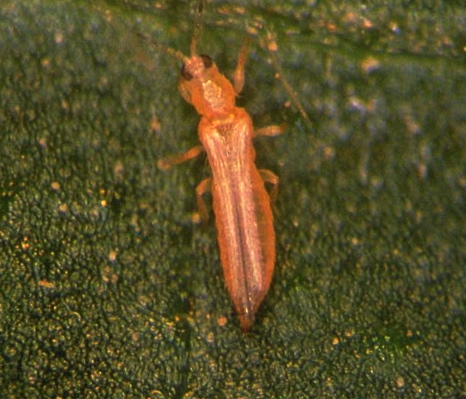
Western flower thrips
Frankliniella occidentalis
Frankliniella occidentalis (Pergande) (Thysanoptera: Thripidae) originated in western North America and has since become a major pest of vegetables, fruit and ornamental crops across the US and around the world. F. occidentalis are small (1-2 mm…
Collapse pest biology
Frankliniella occidentalis (Pergande) (Thysanoptera: Thripidae) originated in western North America and has since become a major pest of vegetables, fruit and ornamental crops across the US and around the world. F. occidentalis are small (1-2 mm long), slender, soft-bodied insects that are yellow to light brown in color; adults have distinctive fringed wings. It can develop quickly, going from egg to adult in two weeks or less at favorable temperatures. Adult females insert eggs into plant tissue under the epidermis. When mature, larvae drop to the soil to go through the prepupal and pupal stages, and finally return to the plants as adults. Larvae and adults feed on flowers, buds, terminals, leaves, and fruit.
Frankliniella occidentalis feed by rasping open plant cells and sucking up the cell contents. The damaged cells collapse, leaving bronzed or russeted areas on the leaves or fruits. Besides the direct plant damage this pest causes, F. occidentalis also transmits several species of destructive plant viruses in the genus Tospovirus (Bunyaviridae), including Tomato Spotted Wilt Virus (TSWV) and Impatiens Necrotic Spot Virus (INSV), of which it is the most important vector worldwide.
Adults can move long distances on air currents to find new food; adults and larvae can also be transported on transplants. Although there are some effective natural enemies of F. occidentalis, growers rely on chemical control to reduce damaging populations of this pest. Natural enemies such as predatory bugs (Orius spp.), lacewings (Chrysoperla spp.) and predatory mites (Amblyseius spp., Neoseiulus spp.) can provide significant control of F. occidentalis populations. The number of effective chemical compounds that control F. occidentalis is very limited and insecticide resistance has been reported to several major classes of insecticides.

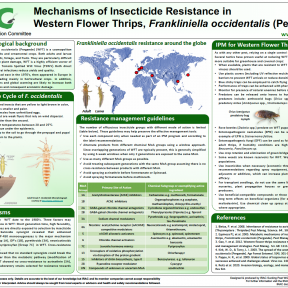
Resistance status
| Insecticide group | Region | Suspected mechanism |
|---|---|---|
| CarbamatesMoA 1A | Europe, Africa, North America | Metabolic: Enhanced detoxification by monooxygenases |
| OrganophosphatesMoA 1B | Europe, Africa, Australia, North America | Metabolic: Enhanced detoxification by monooxygenases |
| Cyclodiene organochlorinesMoA 2A | Europe, Africa, USA | Metabolic |
| Phenylpyrazoles (Fiproles)MoA 2B | Australia | Metabolic |
| Pyrethroids-PyrethrinsMoA 3A | Europe, Australia, USA | MetabMetabolic: Enhanced detoxification by monooxygenases. Also, linked to target site resistance (kdr) |
| NeonicotinoidsMoA 4A | China, Spain | Cytochrome P450 detoxification |
| SpinosynsMoA 5 | Australia, Brazil, China, Spain, USA | Altered target site resistance: G275E mutation in the α6 subunit of nAChR |
| AvermectinsMoA 6 | China, USA | |
| PyriproxyfenMoA 7C | China |
Resistance monitoring
Susceptibility test methods approved by IRAC.
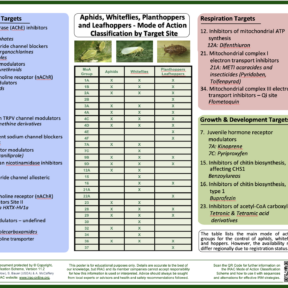
Key resources
Key references
| Reference | Year | Authors | Publisher |
|---|---|---|---|
| Field resistance to spinosad in western flower thrips Frankliniella occidentalis (Thysanoptera: Thripidae)vol. 15 (12) pp. 2803-08. DOI: 10.1016/S2095-3119(16)61478-8 | 2016 | Li D, Shang X, Reitz S, Nauen R, Lei Z, Lee SH, Gao Y | Journal of Integrative Agriculture |
| Field-evolved resistance to insecticides in the invasive western flower thrips Frankliniella occidentalis (Pergande) in ChinaVol. 72 (7) pp.1440-1444, DOI: 10.1002/ps.4200 | 2016 | Wang ZH, Gong YJ, Jin GH, Li BY, Chen JC, Kang ZJ, Zhu L, Gao YL, Reitz S, Wei SJ | Pest Management Science |
| Esterase inhibition by synergists in the western flower thrips Frankliniella occidentalisVol. 67 (12), pp. 1549-1556. DOI: 10.1002/ps.2211 | 2011 | López-Soler N, Cervera A, Quinto V, Abellán J, Bielza P, Martínez-Pardo R | Pest Management Science |