

Housefly
Musca domestica
The housefly, Musca domestica, is a serious threat to human and animal health. Houseflies are vectors of more than 100 human and animal intestinal diseases. They are capable of transmitting parasites that cause diseases such as…
Collapse pest biology
The housefly, Musca domestica, is a serious threat to human and animal health. Houseflies are vectors of more than 100 human and animal intestinal diseases. They are capable of transmitting parasites that cause diseases such as typhoid fever, cholera, bacillary dysentery, infantile diarrhea, tuberculosis, plague, leprosy, yaws, samonellosis, trachoma, and anthrax. Animal health concerns include the transmission of pinkeye. Houseflies can carry streptococcus and staphylococcus which are responsible for mastitis in dairy cattle. They are also responsible for decreased feed conversion, lower milk yields, and they delay the entry of replacement animals into production. The adult flies are not parasitic, but when they lay their eggs in open wounds and these hatch into their larval stage (also known as maggots), the larvae feed on live and/or necrotic tissue, causing accidental myiasis to develop. The livestock industry also has to be aware of the nuisance problems that houseflies cause to neighboring residential areas.
Housefly populations can reach intolerable levels particularly fast. A mature female can produce several clutches of between 100 and 150 eggs. These eggs hatch within a day. The three larval instars last 4-5 days and the fly will remain a pupa for another 4-5 days before it emerges as an adult. The average life cycle from egg to adult under ideal conditions of 27-30ºC lasts 9-12 days. Adults are usually 6-7mm in length with red eyes and a gray thorax containing four dark lines and a pair of membranous wings.

Resistance status
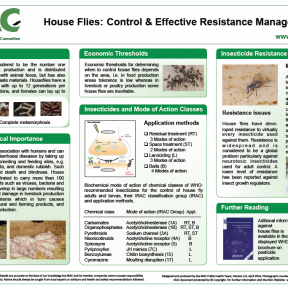
House fly populations have been shown to be resistant to one or more of the major classes of insecticide including: Carbamates – Group 1A Organophosphates – Group 1B Cyclodiene Organochlorines – Group 2A Pyrethroids – Group…
Collapse resistance summary
House fly populations have been shown to be resistant to one or more of the major classes of insecticide including: Carbamates – Group 1A Organophosphates – Group 1B Cyclodiene Organochlorines – Group 2A Pyrethroids – Group 3A DDT – Group 3B Neonicotinoids – Group 4A Spinosyns – Group 5 Avermectins – Group 6 Pyriproxyfen – Group 7C Benzoylureas – Group 15 Cyromazine – Group 17 Indoxacarb – Group 22A
Key resources

Key references
| Reference | Year | Authors | Publisher |
|---|---|---|---|
| Methoxyfenozide resistance of the housefly, Musca domestica L. (Diptera: Muscidae): cross-resistance patterns, stability and associated fitness costsVol. 73 (1), pp. 254-261. DOI: 10.1002/ps.4296 | 2017 | Shah RM, Shad SA, Abbas N | Pest Management Science |
| Insecticide Resistance and Management Strategies in Urban EcosystemsVol. 7(1):2. DOI:10.3390/insects7010002. | 2016 | Zhu F, Lavine L, O’Neal S, Lavine M, Foss C, Walsh D | Insects |
| Risk assessment, cross-resistance potential, and biochemical mechanism of resistance to emamectin benzoate in field strain of house fly (Musca domestica Linnaeus)Vol. 151, pp. 133-137. DOI: 10.1016/j.chemosphere.2016.02.077 | 2016 | Khan HAA, Akram W, Khan T, Haider MS, Iqbal N, Zubair M | Chemosphere |