
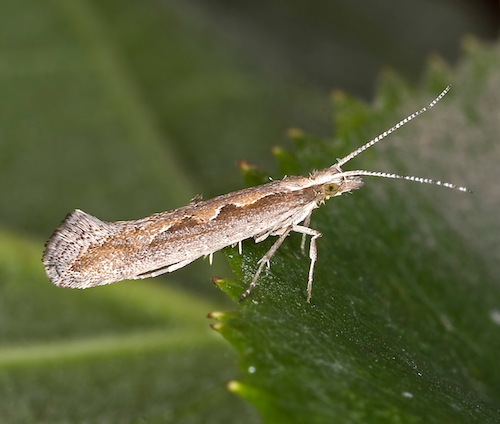
Diamondback Moth
Plutella xylostella
P. xylostella is a highly migratory, cosmopolitan species and one of the most important pest of cruciferous crops worldwide. Globally, direct losses and control costs are estimated to be US$ 1 billion. In temperate regions, P.…
Collapse pest biology
P. xylostella is a highly migratory, cosmopolitan species and one of the most important pest of cruciferous crops worldwide. Globally, direct losses and control costs are estimated to be US$ 1 billion. In temperate regions, P. xylostella are unable to overwinter and therefore annual outbreaks are attributed to migration, but in tropical and subtropical regions there can be a large number of continuous generations per year. P. xylostella is considered to be one of the most difficult pests to control and for many years continuous insecticide applications have been the main tool with the result that today this species shows resistance to almost all insecticides, including recently introduced compounds with new modes of action.

Resistance status
Several biochemical mechanisms are described as conferring resistance to insecticides in P. xylostella. Many of these mechanisms listed below act in concert and can provide resistance factors of 1000-fold or greater. 1. Enhanced metabolic detoxification mechanisms:…
Collapse resistance summary
Several biochemical mechanisms are described as conferring resistance to insecticides in P. xylostella. Many of these mechanisms listed below act in concert and can provide resistance factors of 1000-fold or greater.
1. Enhanced metabolic detoxification mechanisms:
Microsomal monooxygenases – different forms of cytochrome P450 play a major role in P. xylostella resistance to pyrethroids, organophosphates, abamectin and benzoylphenyl ureas.
Glutathione S-transferases – for example reported to confer organophosphate resistance
Carboxylesterases – involved in resistance to organophosphates and other chemical classes of insecticides
2. Insensitive acetylcholinesterase – proven to play a role in P. xylostella resistance development to organophosphates and carbamates.
3. Reduced Cry1C binding to target site in midgut membrane and reduced conversion of Cry1C protoxin to toxin – factors in resistance development to Bacillus thuringiensis protein Cry1C.
4. Knock-down resistance – mutation(s) in voltage-gated sodium channels providing pyrethroid resistance.
5. Other mechanisms – include modified GABA-gated chloride channels and reduced penetration.
Key resources
Key references
| Reference | Year | Authors | Publisher |
|---|---|---|---|
| Dominant Inheritance of Field-Evolved Resistance to Fipronil in Plutella xylostella (Lepidoptera: Plutellidae)Vol. 109 (1), pp. 334-338. DOI: doi.org/10.1093/jee/tov317 | 2016 | Wang X, Wu S, Gao W, Wu Y | Journal of Economic Entomology |
| Geographic spread, genetics and functional characteristics of ryanodine receptor based target-site resistance to diamide insecticides in diamondback moth, Plutella xylostellaVol. 63, pp.14-22. DOI: 10.1016/j.ibmb.2015.05.001 | 2015 | Steinbach D, Gutbrod O, Lümmen P, Matthiesen S, Schorn C, Nauen R | Insect Biochemistry and Molecular Biology |
| Frequencies of the M918I mutation in the sodium channel of the diamondback moth in China, Thailand and Japan and its association with pyrethroid resistanceVol. 102 (2), pp. 142-145. DOI: 10.1016/j.pestbp.2011.12.005 | 2012 | Sonoda S, Shi X, Song D, Zhang Y, Li J, Wu G, Liu Y, Li M, Liang P, Wari D, Matsumura M, Minakuchi C, Tanaka T, Miyata T, Gao X | Pesticide Biochemistry and Physiology |
 Insecticide Resistance Management for Diamondback Moth in Cole Crops