
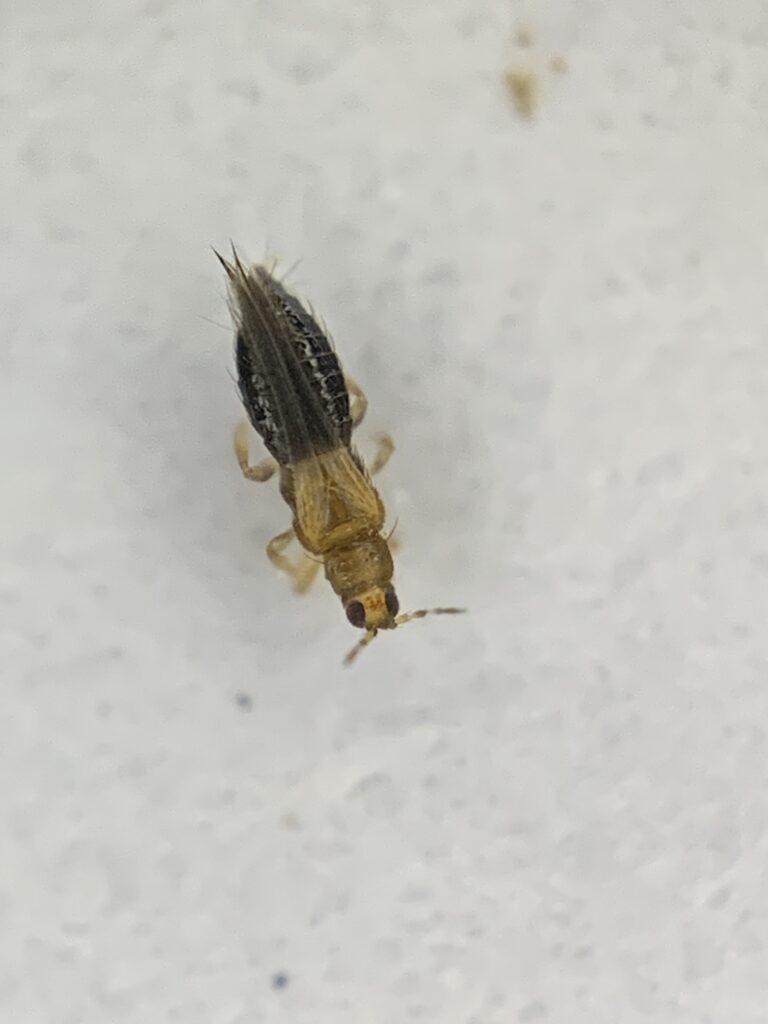
Southeast Asian Thrip

Thrips parvispinus

Chilli (hot pepper) crop is mostly damaged by chilli thrips (Scirtothrips dorsalis Hood) and species such as Frankliniella occidentalis, Thrips tabaci and Frankliniella schultzii of which T. tabaci and F. schultzii are present worldwide in peppers predominantly.…

Expand pest biologyCollapse pest biology

Chilli (hot pepper) crop is mostly damaged by chilli thrips (Scirtothrips dorsalis Hood) and species such as Frankliniella occidentalis, Thrips tabaci and Frankliniella schultzii of which T. tabaci and F. schultzii are present worldwide in peppers predominantly. Adding to the list of damaging thrips is the tobacco thrips or invasive thrips or Southeast Asian thrips, Thrips parvispinus.

One of the first reports of T. parvispinus was by Waterhouse (1993) from Indonesia, Thailand, and Malaysia; later by Sartiami et. al. 2011. T. parvispinus became the dominant thrips species in Indonesia, replacing Thrips palmi in several vegetable fields (Murai et al. 2010). They found damage from these thrips occurred in several vegetable crops, such as chilli pepper, paprika, green bean, potato, strawberry and eggplant in Bali and Bogor in Indonesia. Over the past two decades this species has been reported from China (Mirab-Balou et al. 2011), Australia (Mound, Masumoto. 2005), India (Tyagi et al. 2015, Rachana et al. 2018), Tanzania, Uganda (Moritz et al. 2013), Ghana (Fening et al. 2022), Greece (Mound and Collins. 2000), France, Spain; The Netherlands (NPPO 2019) and USA (Soto-Adames. 2020).

The host range has been well documented and is reported to be feeding on more than 40 host plants that include Gardenia, roses, chilli pepper, fiber crops, legumes, and fruits (Ahmed et al. 2023, Rachana et al. 2022, Sartiami and Mound. 2013, Hutasoit et al. 2019). T. parvispinus belongs to “Thrips orientalis group” (Mound and Masumoto. 2005) and has been well described. The females are two-toned while the males are like chilli thrips and are much smaller in size (Ahmed et al. 2023). Both the sexes of this species are fully winged. Females are nearly 1 mm long, with brown head and prothorax, yellowish brown meso- and metathorax and black abdomen; forewings are dark with pale coloured base, seven-segmented antenna with segment III and basal half of IV, V in yellow colour. Males are 0.6 mm long and evenly yellow (Soto-Adames. 2020 and Hutasoit et al. 2017).

Under controlled study conditions on chilli pepper, Hutasoit et al. 2017 reported that the females live for nine days, the males live for six days and the total life cycle is completed in 13-14 days. Females lay 15 eggs on an average and eggs are inserted into leaves. Larvae (nymphs) molt twice in 4-5 days and there are two pupalstages lasting 2-3 days.T. parvispinus mainly colonize flowers and the underside of leaves while the larval growth mainly occurs on the underside of leaves. T. parvispinus males feed on the underside of the leaves causing deep punctures and scratches on leaves. At times, necrotic areas on the leaf lamina and yellow streaking are also observed. Adults (particularly females) have been observed to feed and hide in the nectariferous area of chilli flowers resulting in withering of flowers and a reduced fruit set. The feeding by larvae causes scarring and discolour on and in developing fruits. Yield losses can be severe for both peppers and eggplant. Though difficult to see in plants, thrips can be seen by shaking flowers and new foliage over a white sheet of paper.

Other common names

Tobacco thrip, Invasive thrip

Distribution map for Southeast Asian Thrip
Global distribution of southeast asian thrip

Key resources

All resources →

Key references

Key references
ReferenceYearAuthorsPublisher
Thrips parvispinus (Karny), an emerging invasive regulated pest in the United States 2024Ahmed MZ, Revynthi AM, McKenzie CL, Osborne LSUniversity of Florida
Invasive pest, Thrips parvispinus (Karny) (Thysanoptera: Thripidae) – a looming threat to Indian agricultureVol 122, Issue 2, p211 2022Rachana RR, Roselin P, Amutha M, Sireesha K, Reddy GNCurrent Science
First report and population dynamics of the Tobacco Thrips, Thrips parvispinus (Karny)(Thysanoptera: Thripidae) on ridged gourd, Luffa acutangula (L.) Roxy in selected export fields in southern Ghana123(2), 235-245 2022Fening KO, Amouzou K, Hevi W, Forchibe EE, Billah MK, Wamonje FOJournal of Agriculture and Rural Development in the Tropics and Subtropics (JARTS)
Expand referencesCollapse references
Key references
ReferenceYearAuthorsPublisher
Pest Alert: Thrips parvispinus (Karny)FDACS-P-01926 2020Soto-Adames FNFlorida Department of Agriculture and Consumer Services Division of Plant Industry
Netherlands Plant Protection Organization: Thrips parvispinusQS.Ent/2019/001 2019Netherlands Plant Protection OrganizationNetherlands Plant Protection Organization
The Abundance and Diversity of Thrips (Thysanoptera: Thripidae) on Chili (Capsicum annum L.) and Cayenne (Capsicum frutescens L.) in BogorVol. 19, No. 1, Pages: 33–41 2019Hutasoit RT, Triwidodo HJURNAL HAMA DAN PENYAKIT TUMBUHAN TROPIKA
Report of invasive thrips species, Thrips parvispinus (karny) (Thripidae: Thysanoptera) on dahlia rosea (Asteraceae) in Karnataka24 (2), 175-176 2018Rachana RR, Roselin P, Varatharajan RPest Management in Horticultural Ecosystems
Biology and demographic statistic of Thrips parvispinus Karny (Thysanoptera: Thripidae) in chili pepper (Capsicum annuum Linnaeus)Vol. 14 No. 3, 107–116 2017Hutasoit RT, Triwidodo H, Anwar RJurnal Entomologi Indonesia
Morphological and DNA barcoding evidence for invasive pest thrips, Thrips parvispinus (Thripidae: Thysanoptera), newly recorded from India15(1):105. doi: 10.1093/jisesa/iev087 2015Tyagi K, Kumar V, Singha D, Chakraborty RJournal of Insect Science
Identification and information tools for pest thrips in East Africa. CBIT Publishing, QueenslandDOI:10.13140/2.1.5173.8409 2013Moritz G, Brandt S, Triapitsyn S, Subramanian SQBIT, QAAFI Biological Information Technology, The University of Queensland, Australia
Identification of the terebrantian thrips (Insecta, Thysanoptera) associated with cultivated plants in Java(306):1-21. doi: 10.3897/zookeys.306.5455 2013Sartiami D, Mound LAZookeys
Thrips parvispinus Karny (Thysanoptera: Thripidae) pada tanaman cabai: Perbedaan karakter morfologi berdasarkan ketinggian tempat Vol. 8 No. 2 2011Sartiami D, Magdalena M, Nurmansyah AJurnal Entomologi Indonesia
Thrips (Insecta: Thysanoptera) of China7(6), 720-744 2011Mirab-Balou M, TSL, Feng JN, Chen XXCheckList
IXth International Symposium on Thysanoptera and TospovirusesVolume 10, Issue 1, 166 2010Persley D, Wilson C, Thomas J, Sharman M, Tree DJournal of Insect Science
Damage to vegetable crops by Thrips parvispinus Karny (Thysanoptera: Thripidae) and preliminary studies on biology and control10(141):27–28 2010Murai T, Watanabe H, Toriumi W, Adati T, Okajima SJournal of Insect Science
The genus Thrips (Thysanoptera, Thripidae) in Australia, New Caledonia and New Zealand1020(1), 1–64 2005Mound LA, Masumoto MZootaxa
A southeast Asian pest species newly recorded from Europe: Thrips parvispinus (Thysanoptera: Thripidae), its confused identity and potential quarantine significance97: 197–200 2000Mound LA, Collins DWEuropean Journal of Entomology
The Major Arthropod Pests and Weeds of Agriculture in Southeast AsiaACIAR Monograph No. 21 1993Waterhouse DFAustralian Centre for International Agricultural Research

External links